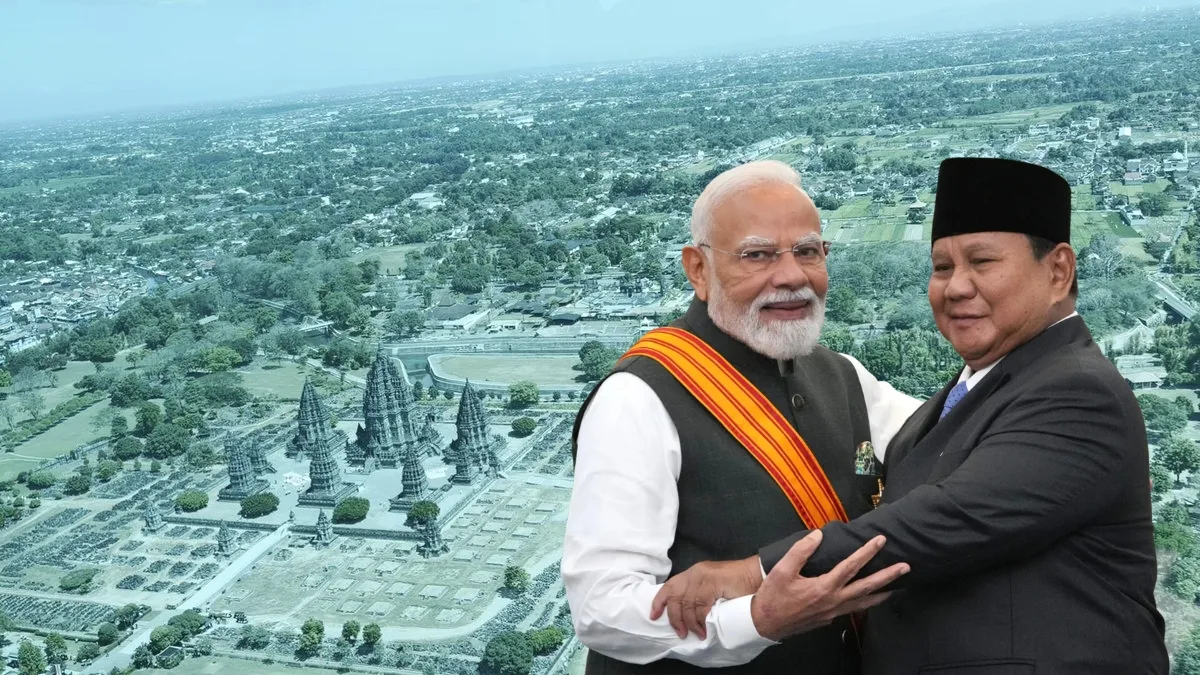
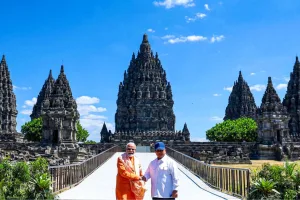
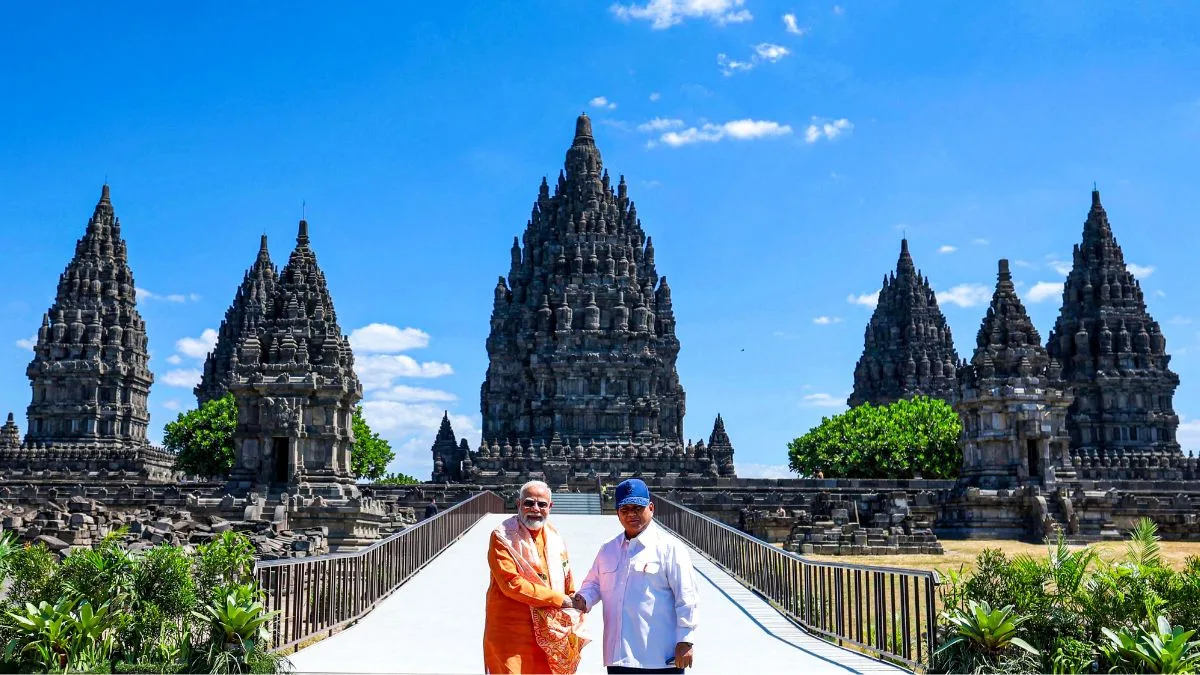
Prime Minister Narendra Modi reached the Prambanan Temple complex in Yogyakarta, Indonesia, alongside President Prabowo Subianto. Modi launched a conservation project for the 1,000-year-old temple during this visit, part of a two day trip to Indonesia on Prabowo’s invitation.
A day before, Modi told a joint press conference in Jakarta that he would have the privilege of launching the conservation project alongside Prabowo. He called Prambanan “another remarkable testament” to civilisational ties between the two countries stretching back over a thousand years.
Advertisement
Here is the full picture.
Why India is involved
According to India’s ambassador to Indonesia, Sandeep Chakravorty, the visit links directly to a commitment made in the 2025 Indonesia-India Joint Statement, where both countries agreed India would support Prambanan’s restoration.
The Indian government has worked with Indonesia’s Ministry of Culture, the Indonesian Heritage Agency, and the Archaeological Survey of India to prepare the project. An ASI team already visited the site, assessed the temple, and prepared a project report now under review.
Indonesia’s Culture Minister Fadli Zon said the cooperation will target the perwara, the smaller companion shrines around Prambanan’s three main temples. ASI has restored monuments abroad before. In 2014 it worked on the My Son Sanctuary in Vietnam. And, in 2021 it helped rebuild the Ramna Kali Temple in Bangladesh. In 2022 it restored parts of Angkor Wat and Ta Prohm in Cambodia. In 2024 it worked on the Vat Phou Temple in Laos. It is currently running similar projects in Laos and Vietnam alongside this one.
Who built it and when
Construction began around 850 CE, during the reign of Rakai Pikatan, a king of the Sanjaya Dynasty in the Mataram Kingdom. Historians believe Prambanan was built to mark the return of Hindu rule in Java after decades of Buddhist rule under the Sailendra Dynasty. Pikatan later married Pramodhawardhani, a Sailendra princess, merging the two rival dynasties and folding both Hinduism and Buddhism into the kingdom. The main Shiva temple was inaugurated around 856 CE.
Prambanan sits about 50 years after Borobudur, the great Buddhist monument nearby, and at 47 metres it stands slightly taller.
Layout and design
The complex follows a mandala plan, laid out as three concentric squares. The central compound holds eight main temples and eight smaller shrines. Three temples honour the Trimurti, the three central Hindu gods. Brahma’s temple sits to the north, Vishnu’s to the south, and Shiva’s stands between them, taller and more central than the rest.
Each zone of the layout carries meaning. Outer square represents ordinary human world filled with everyday life and worldly attachment. The middle square, once holding four rows of 224 identical smaller shrines, marks a transition zone for those who have begun to let go of worldly matters. The innermost zone, raised and crowned, represents the realm of the gods. The rising spires of each shrine echo Mount Meru, the mountain home of the gods in Hindu belief, and the vertical climb through each structure was meant to mirror a soul’s ascent toward the divine.
Inside the Shiva temple
The Shiva temple holds a large statue of Shiva Mahadeva in its main chamber. Other chambers hold additional sculptures, including one of the goddess Durga. Local tradition ties this Durga figure to the legend of Roro Jonggrang, and the temple carries that name locally, Candi Roro Jonggrang, meaning Temple of the Slender Maiden.
The Roro Jonggrang legend
Folklore holds that a prince named Bandung Bondowoso wanted to marry a princess, Roro Jonggrang, after defeating and killing her father, King Boko. She could not refuse him directly, so she set an impossible condition: he had to build a thousand temples in a single night, finished before the roosters crowed.
Using supernatural helpers, Bondowoso came close to finishing, completing 999 temples. Sensing his success, Roro Jonggrang had the palace women pound rice and light fires to mimic the coming of dawn. The spirits fled, believing morning had broken, leaving the work short by one temple. Furious at the trick, Bondowoso cursed her into stone to serve as the final, thousandth statue. Local belief holds that this is the Durga statue standing in the Shiva temple today.
The legend also links Prambanan to two nearby sites. Ratu Boko, a hillside palace complex about 17 kilometres from Yogyakarta, is tied to the legendary King Boko. Candi Sewu, a separate Buddhist temple compound just north of Prambanan, is said in the legend to be the unfinished thousand temples, since “sewu” means thousand in Javanese. In real history, Candi Sewu was a genuine Buddhist compound built around the same period as Ratu Boko, and it ranks as the second largest Buddhist temple complex on Java after Borobudur.
Decline and rediscovery
The temple fell into decline in the 10th century when the Mataram dynasty shifted its base to East Java. It suffered further damage from a major earthquake in the 16th century. Alongside was volcanic activity and long stretches of abandonment. A Dutchman named C.A. Lons is credited with rediscovering the site in 1733. This happened after it had lain buried under dirt and jungle growth for centuries.
Formal restoration began under Dutch colonial administration in the early 20th century. Major work recorded from 1918 onward, combining traditional interlocking stone methods with modern reinforcement using concrete. The site suffered fresh damage as recently as the May 2006 Java earthquake.
Recognition and present day use
UNESCO inscribed the Prambanan Temple Compounds as a World Heritage Site in 1991. Indonesia separately designated it as National Cultural Property in 1998. The site remains an active place of Hindu worship. This happens especially during festivals like Maha Shivaratri, and draws millions of visitors each year.
During full moon evenings from May to October, the Ramayana ballet is performed in open air theatre on southern side. It draws on the same Ramayana story told through stone reliefs carved across the complex.